Table of Contents
When buyers compare rubber-coated fabrics, temperature resistance is often one of the first specifications they check. However, a temperature figure such as “continuous use at 200°C” or “short-term resistance to 300°C” does not tell the complete story.
The more important questions are:
- How long was the material exposed to heat?
- Was the exposure continuous, intermittent, or cyclic?
- Which properties were measured before and after exposure?
- Was the rubber coating tested, or was the complete coated fabric tested?
- Was the material exposed to hot air, direct contact, radiant heat, pressure, chemicals, or mechanical movement?
- Were the test conditions representative of the actual application?
I am Tina Tian from YEEDAH. In my work with industrial customers, I often help buyers evaluate silicone-coated fiberglass fabric, neoprene-coated fiberglass fabric, PVC-coated fabric, flexible ducting, and fabric duct connectors.
From a technical purchasing perspective, I believe temperature resistance should not be judged from one maximum-temperature figure alone.
The purpose of temperature testing is to understand how a material behaves under defined thermal conditions and whether it retains the properties required for its intended application.
Why Temperature-Resistance Testing Matters
Rubber-coated fabrics are composite materials. Their performance depends on more than the coating polymer.
The complete construction may include:
- A rubber or polymer coating
- A woven textile substrate
- Adhesion between coating and substrate
- Surface treatments
- Reinforcement materials
- Seams and joining components
- Cuffs, clamps, or other components in the finished product
Heat can affect these components differently.
After thermal exposure, a coated fabric may experience:
- Hardening or softening
- Loss of flexibility
- Surface cracking
- Discoloration
- Dimensional change
- Reduction in tensile strength
- Reduction in tear strength
- Reduced coating adhesion
- Delamination
- Changes in sealing or barrier performance
A sample may look acceptable after heating while its mechanical properties have already changed significantly.
For this reason, visual inspection alone is not sufficient when thermal performance is important. A useful evaluation should connect the exposure conditions with measurable changes in the properties that matter for the application.
What Does “Temperature Resistance” Actually Mean?
Temperature resistance is not one single material property.
Depending on the application, it may refer to performance during:
- Long-term exposure at an operating temperature
- Short-term exposure to a higher temperature
- Repeated heating and cooling
- Low-temperature flexing
- Heat exposure combined with mechanical loading
- Heat exposure combined with chemicals or moisture
These conditions should not be treated as interchangeable.
Continuous Operating Temperature
A continuous operating temperature describes the temperature at which a material is intended to operate for an extended period.
However, a continuous operating temperature should not automatically be interpreted as a universal guaranteed lifetime limit.
Long-term performance can depend on:
- Actual exposure time
- Temperature fluctuations
- Oxygen or other environmental conditions
- Mechanical stress
- Chemical exposure
- Coating formulation
- Coating thickness
- Base fabric
- Curing quality
A material used continuously near its practical thermal limit may age differently from the same material used at a substantially lower temperature.
Therefore, when a supplier provides a continuous temperature range, buyers should also ask what test data or application experience supports the stated range.
Short-Term or Peak Temperature
Industrial equipment may occasionally experience temperatures higher than its normal operating temperature.
For example, a flexible duct may normally operate at one temperature but experience a brief temperature spike during equipment start-up or process changes.
A short-term exposure test can help evaluate this condition.
However, a short-term exposure result should always include:
- Exposure temperature
- Exposure duration
- Number of exposure cycles
- Environmental conditions
- Mechanical conditions
- Evaluation criteria
A statement such as “resistant to 300°C” is therefore incomplete without knowing how long the material was exposed and what happened to its properties afterward.
Short-term temperature resistance should not automatically be interpreted as continuous service temperature.
Low-Temperature Performance
Temperature resistance also includes behavior at low temperatures.
Some coated fabrics become stiffer as temperature decreases. This may not be obvious while the material is flat, but cracking can occur when it is folded, bent, or otherwise deformed.
ISO 4675:2017 specifically provides a low-temperature bend test for rubber- or plastics-coated fabrics. The method evaluates the material after exposure to a specified low temperature and bending condition.
This type of testing can be particularly relevant to:
- Outdoor flexible ducting
- Vehicle components
- Flexible connectors
- Equipment covers
- Materials installed or stored in cold environments
The result should still be interpreted in relation to the actual application because laboratory deformation conditions may differ from field conditions.
Heat Resistance Is Not the Same as Flame Resistance
This distinction is particularly important for industrial materials.
Heat-aging tests generally examine how material properties change after exposure to elevated temperature.
Flame-related tests address different characteristics, such as behavior when exposed to an ignition source or flame.
Depending on the applicable standard, fire testing may consider properties such as:
- Ignition
- Flame spread
- Afterflame
- Afterglow
- Burning behavior
- Dripping
Therefore:
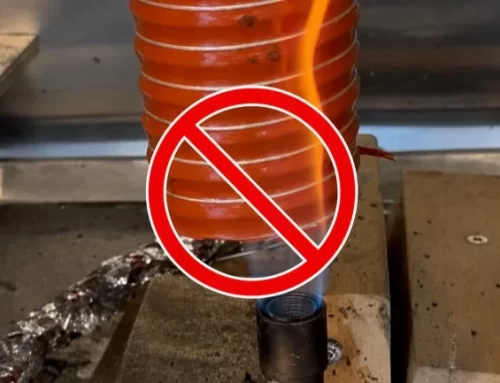
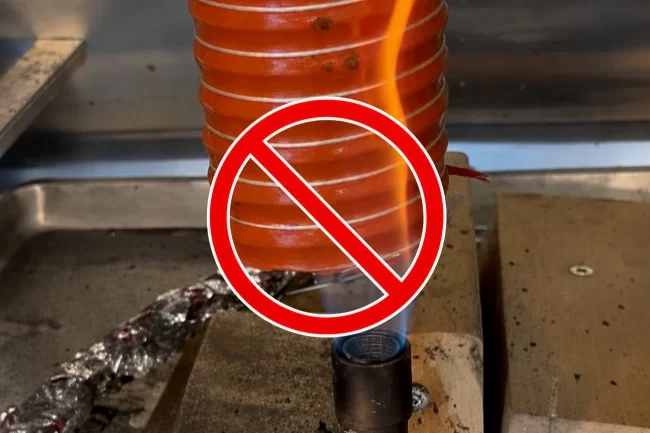
Resistance to hot air does not automatically mean resistance to direct flame.
Likewise, passing a particular flame-retardancy test does not automatically prove that a coated fabric can maintain its mechanical properties during long-term high-temperature exposure.
Thermal insulation is also a separate consideration. A fabric may tolerate a high temperature on one side while providing limited insulation against heat transfer.
What Influences the Temperature Performance of Coated Fabric?
When evaluating a coated fabric, I recommend looking at the complete construction rather than the coating polymer alone.
Important factors include:
- Coating chemistry and formulation
- Coating thickness
- Coating coverage
- Curing conditions
- Base fabric material
- Fabric construction and weave
- Coating-to-fabric adhesion
- Total thickness
- Number of coated sides
- Surface treatment
- Finished-product construction
Two products may both be described as “silicone-coated fiberglass fabric” but perform differently because their coating formulations, coating weights, fiberglass constructions, thicknesses, or curing conditions are different.
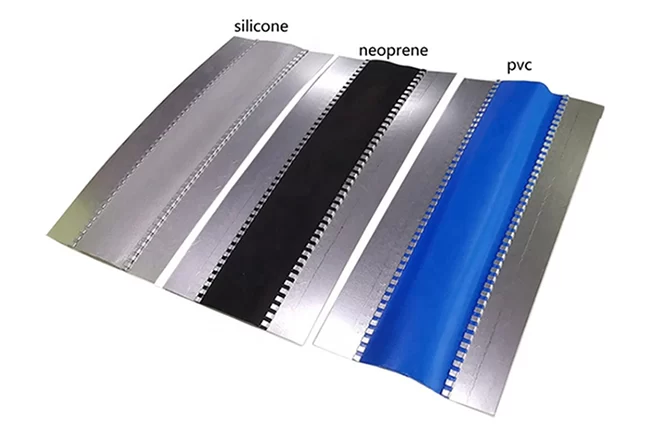
Silicone-Coated Fiberglass Fabric
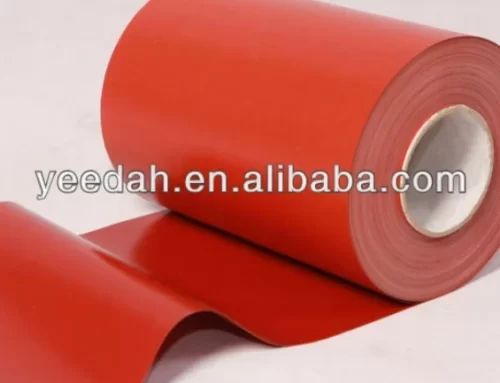
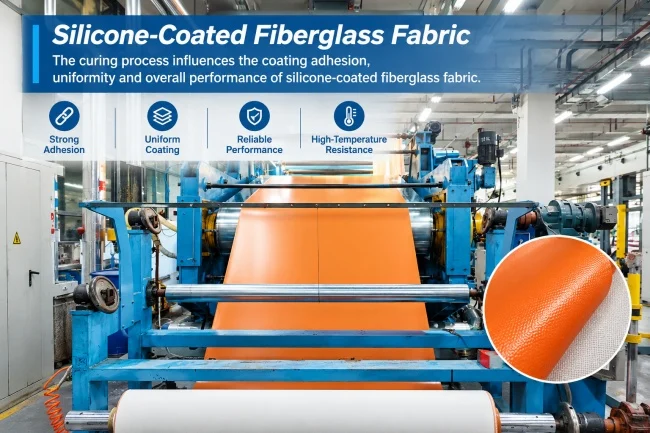
Silicone-coated fiberglass fabric combines a fiberglass textile substrate with a silicone rubber coating.
The fiberglass substrate contributes reinforcement and dimensional stability, while the silicone coating provides properties such as flexibility and environmental resistance.
For thermal evaluation, relevant properties may include:
- Tensile strength after aging
- Tear strength after aging
- Coating adhesion
- Flexibility
- Surface condition
- Dimensional stability
- Coating continuity
- Sealing or air-leakage performance when relevant
The important point is that testing a silicone rubber compound alone does not automatically qualify the complete silicone-coated fiberglass fabric.
Neoprene-Coated Fiberglass Fabric
Neoprene-coated fiberglass fabric is used in a range of industrial flexible applications where temperature resistance is combined with properties such as weather resistance, abrasion resistance, or flexibility.
Potential applications include:
- Flexible ducting
- Duct connectors
- Equipment covers
- Industrial flexible components
The thermal performance of neoprene-coated fabric depends on the actual compound formulation and construction.
Therefore, buyers should avoid assuming that all neoprene-coated fiberglass fabrics have the same temperature capability.
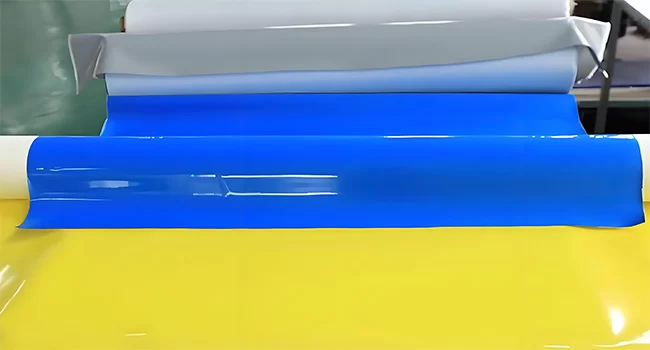
PVC-Coated Fabric
PVC-coated fabrics are widely used in flexible industrial products where properties such as flexibility, fabrication convenience, water resistance, and cost are important.
At elevated temperatures, PVC-coated materials can experience changes such as:
- Softening
- Dimensional change
- Loss of flexibility
- Surface changes
- Deformation under load
The textile substrate also affects the overall behavior.
For this reason, the suitability of a PVC-coated fabric near an elevated-temperature application should be confirmed using the actual construction and operating conditions rather than a generic PVC temperature assumption.
How Heat-Aging Tests Are Conducted
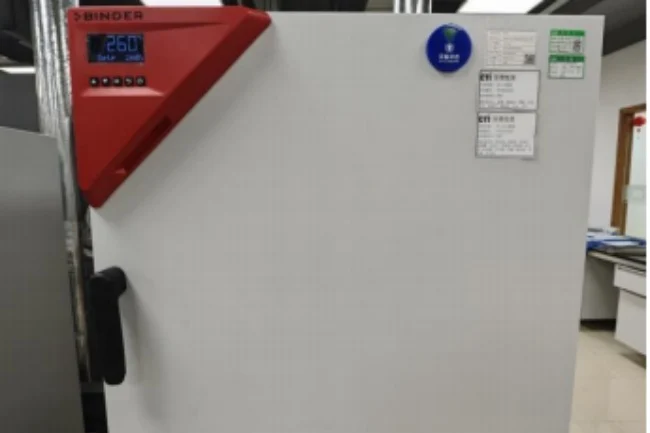
Environmental test chamber used for controlled high-temperature testing of silicone coated fabric samples.
For coated fabrics, accelerated ageing is an important way of evaluating how the material changes after controlled thermal exposure.
ISO 1419:2019 specifically addresses accelerated-ageing tests for rubber- or plastics-coated fabrics and describes methods for assessing deterioration caused by accelerated ageing. The 2019 edition remains the current version according to ISO.
A typical evaluation may involve the following stages.
1. Identify the Test Material
The laboratory or manufacturer should clearly identify the material being tested.
Relevant information may include:
- Product code
- Coating material
- Base fabric
- Thickness
- Mass per unit area
- Color
- Coated side or sides
- Production batch
- Sample direction
This is important because test data are only meaningful if the tested construction corresponds to the material being evaluated for production.
2. Measure the Original Properties
Depending on the purpose of the test, the original specimen may be evaluated for properties such as:
- Thickness
- Mass per unit area
- Tensile strength
- Elongation
- Tear strength
- Coating adhesion
- Flexibility
- Appearance
- Dimensional characteristics
For example, ISO 1421:2016 provides methods for determining tensile strength and elongation at break of rubber- or plastics-coated fabrics.
ISO 2411:2024 provides a method for determining coating adhesion strength of coated fabrics.
The exact tests should be selected according to the product specification and application.
3. Expose the Specimens to Controlled Heat
The specimens are exposed to a specified thermal condition for a defined period.
The test plan should identify relevant conditions such as:
- Exposure temperature
- Exposure duration
- Number of exposure cycles
- Test atmosphere
- Specimen arrangement
- Applicable conditioning requirements
The exact conditions depend on the selected test method.
For rubber compounds and rubber products, ASTM D573 and ISO 188 are commonly encountered heat-aging standards.
ASTM D573 covers the effect of elevated temperature on the physical properties of vulcanized rubber. ASTM specifically notes that the results may not provide an exact correlation with service performance because real service conditions can vary significantly.
ISO 188:2023 similarly specifies accelerated ageing and heat-resistance tests for vulcanized or thermoplastic rubber and thermoplastic elastomers.
These standards are useful, but they should not be presented as if they automatically qualify a complete rubber-coated fabric.
- for extended exposure
- A higher temperature for short-term exposure
- Repeated heating and cooling
- Low-temperature flexibility
A five-minute exposure at a high temperature answers a different question from a multi-day heat-aging test at a lower temperature.
The two results should not be treated as interchangeable.
Accelerated aging can be useful for comparing materials, but it should not automatically be converted into an exact real-world service lifetime.
The relationship between accelerated laboratory aging and actual service life depends on the material, degradation mechanism, environment, and application.
What Should Be Controlled During Thermal Testing?
Temperature accuracy is important, but it is not the only consideration.
Depending on the test method, factors such as the following may influence the result:
- Temperature uniformity
- Specimen position
- Sample orientation
- Exposure atmosphere
- Specimen dimensions
- Conditioning
- Exposure duration
- Number of specimens
- Mechanical restraint
The test method should define the relevant requirements.
For formal qualification, it is preferable to use a recognized test method rather than an undocumented internal procedure.
What Properties Should Be Evaluated After Heat Exposure?
A useful evaluation should consider both visible changes and measurable properties.
Visual and Dimensional Changes
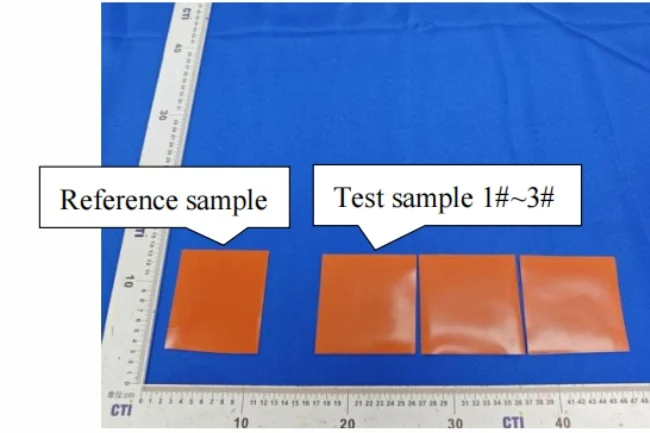
Reference and test samples of silicone coated fabric prepared for comparison after high-temperature exposure.
The specimen may be examined for:
- Cracking
- Blistering
- Delamination
- Discoloration
- Surface changes
- Tackiness
- Powdering
- Exposed yarns
- Curling
- Shrinkage
- Permanent deformation
Visual inspection is useful, but it should not be the only criterion.
A color change does not necessarily mean functional failure.
Conversely, a material can maintain a relatively normal appearance while losing significant tensile strength or adhesion.
Mechanical Property Retention
Mechanical testing can determine whether the material retains sufficient strength after thermal exposure.
Possible measurements include:
- Tensile strength
- Elongation
- Tear strength
- Puncture resistance
- Other application-specific mechanical properties
For coated fabrics, specimen direction can also matter because woven fabrics may have different properties in the warp and weft directions.
ISO 1421:2016 provides recognized tensile-testing methods for rubber- or plastics-coated fabrics.
Coating Adhesion
Heat can affect the bond between the coating and the textile substrate.
This is important because loss of adhesion may eventually result in:
- Delamination
- Leakage
- Exposed reinforcement
- Reduced protection
- Premature failure
ISO 2411:2024 specifies a method for determining coating adhesion strength in rubber- or plastics-coated fabrics.
If adhesion is important to the application, testing before and after thermal exposure can provide useful information.
Flexibility After Heat Exposure
Some materials become harder or less flexible after aging.
For flexible products, it can therefore be useful to combine thermal aging with a bending or flexing evaluation.
This is particularly relevant to:
- Flexible ducts
- Duct connectors
- Expansion joints
- Protective covers
- Moving flexible components
The appropriate bending or flexing method should be selected according to the product and application.
Barrier and Leakage Performance
For a coated fabric that functions as an air, gas, dust, or liquid barrier, additional application-specific testing may be required.
Depending on the product, this could include:
- Air leakage
- Air permeability
- Pressure leakage
- Hydrostatic resistance
- Coating continuity
These are not automatically part of every heat-aging test. They should be added when the barrier function is important to the finished application.
How Short-Term High-Temperature Tests Differ From Heat Aging
A short-term high-temperature evaluation is intended to answer a different question from long-duration heat aging.
A useful short-term evaluation may include:
- Measuring the original specimen.
- Exposing it to a specified high temperature.
- Maintaining that condition for a defined period.
- Cooling the specimen according to the applicable procedure.
- Inspecting the material.
- Repeating relevant mechanical or adhesion tests.
- Repeating the thermal cycle when the application involves repeated temperature spikes.
The report should state the exposure temperature and the exposure time.
For example, “exposed to X°C for Y minutes under defined conditions” provides much more useful information than simply stating “tested to X°C.”
Air Temperature Is Not Always the Same as Product Temperature
For some applications, the surrounding air temperature and the actual material temperature can differ.
This may happen because of:
- Heat-transfer characteristics
- Material thickness
- Airflow
- Contact with another material
- Radiant heat
- Insulation
- Product geometry
Therefore, the actual application should be considered when interpreting laboratory temperature data.
Low-Temperature Testing and Thermal Cycling
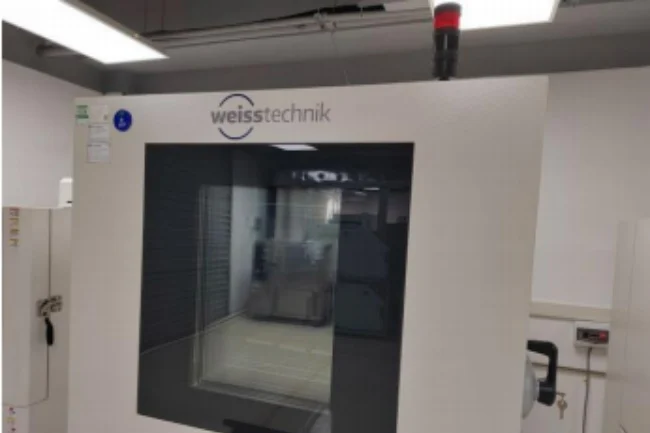
Low-temperature test chamber used to evaluate the performance of coated fabric samples under controlled cold conditions.
Industrial coated fabrics may experience repeated heating and cooling rather than one stable temperature.
For low-temperature performance, ISO 4675:2017 provides a low-temperature bend test for rubber- or plastics-coated fabrics.
ISO 4646:2022 provides a low-temperature impact method for coated fabrics and evaluates whether the material develops fractures or coating cracks under specified conditions.
For applications involving repeated temperature changes, a thermal-cycle program may also be useful.
A thermal-cycle program should define:
- High temperature
- Low temperature
- Heating rate where relevant
- Cooling rate where relevant
- Dwell time
- Number of cycles
- Mechanical condition
- Acceptance criteria
Thermal cycling can be useful for composite materials because different components may respond differently to changes in temperature.
Temperature Testing Under Real Operating Conditions
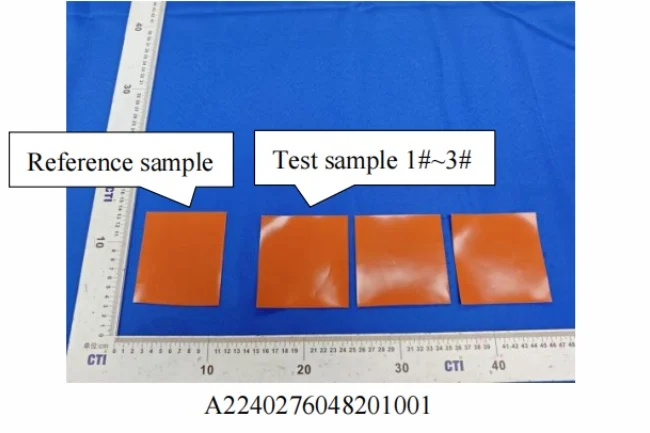
Reference and test samples of silicone coated fabric prepared for evaluation after low-temperature exposure.
Laboratory heat-aging tests provide controlled and comparable information, but they do not necessarily reproduce every field condition.
Actual service may combine heat with:
- Pressure
- Airflow
- Vibration
- Flexing
- Abrasion
- Oil or chemical exposure
- Moisture
- Condensation
- Outdoor weathering
- Radiant heat
When several of these factors are important, laboratory aging should be treated as baseline information rather than the complete qualification of the finished product.
Example: Flexible Ducting and High-Temperature Hoses
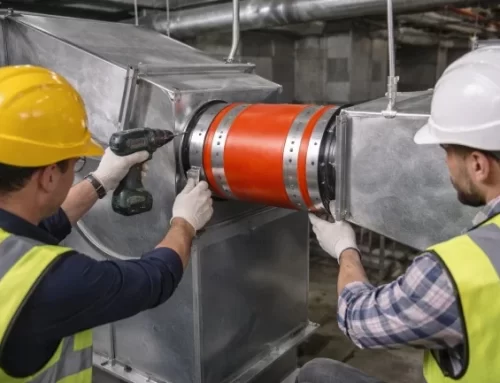
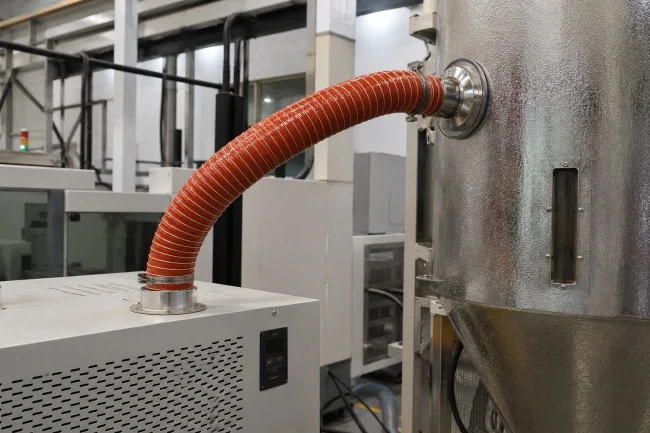
For flexible ducting, testing a flat piece of coated fabric may not be enough to qualify the complete hose.
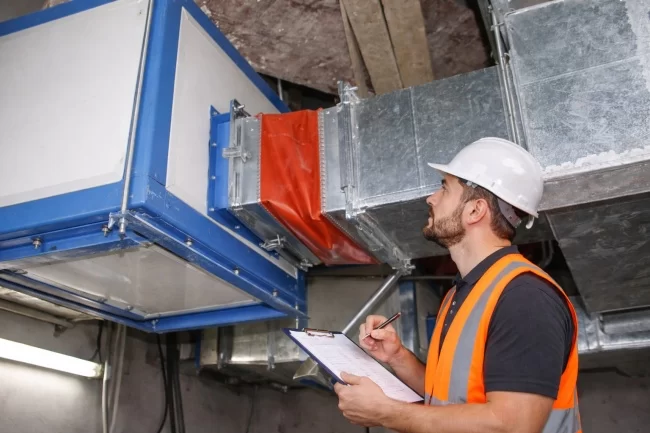
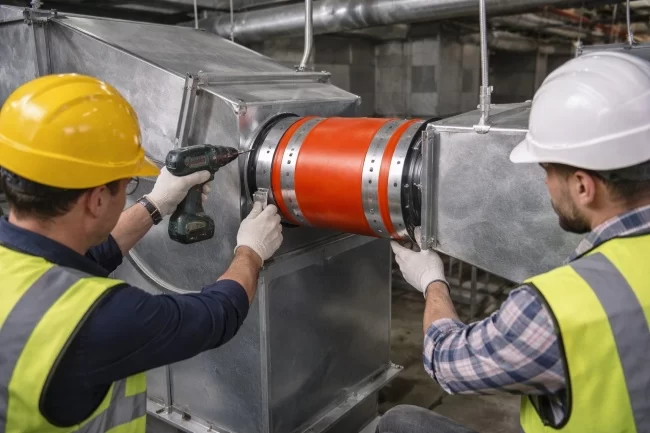
A finished flexible duct may include:
- Coated-fabric wall
- Embedded spring-steel wire
- Reinforcement cord
- End cuffs
- Seams or joints
- Clamps
- Connection components
The finished hose may therefore need to be evaluated under conditions representative of actual use, such as:
- Internal air temperature
- Internal pressure or vacuum
- Airflow
- Bend radius
- Repeated movement
- Vibration
- Connection method
- External temperature
A hose can use a heat-resistant fabric while another component, such as a cuff, seam, clamp, or connection area, becomes the limiting factor.
Example: Fabric Duct Connectors and Expansion Joints
Flexible duct connectors and non-metallic expansion joints may experience both temperature and mechanical movement.
Relevant conditions may include:
- Axial movement
- Lateral movement
- Angular movement
- Vibration
- Pressure
- Thermal cycling
- Chemical exposure
For these products, the finished assembly may need to be tested rather than relying only on flat-fabric data.
Particular attention should be given to seams and attachment areas because local stresses can be different from those in the center of the fabric.
Example: Welding and Removable Insulation Products
Welding blankets, removable insulation jackets, valve covers, and similar products may encounter different forms of heat, including:
- Radiant heat
- Contact with hot surfaces
- Sparks
- Molten-metal splash
- Short flame exposure
- Repeated handling
An oven-aging test alone cannot represent all of these conditions.
Where flame, sparks, or molten-metal exposure is part of the application, the appropriate application-specific or fire-related testing should be considered separately.
Common Standards Used in Evaluation
Several standards may appear in technical documentation for rubber-coated fabrics. However, each standard addresses a particular property or material category.
ISO 1419:2019 — Accelerated Ageing Tests
ISO 1419:2019 specifically addresses accelerated ageing tests for rubber- or plastics-coated fabrics. It describes methods for assessing deterioration of coated fabrics caused by accelerated aging. ISO currently lists this 2019 edition as the current version.
For a blog specifically about temperature testing of coated fabrics, this is one of the most relevant standards to mention.
ISO 188:2023 — Rubber Heat Aging
ISO 188:2023 covers accelerated ageing and heat-resistance testing of vulcanized rubber, thermoplastic rubber, and thermoplastic elastomers.
It can be useful when evaluating the rubber compound or rubber component, but it should not automatically be described as a complete coated-fabric qualification test.
ASTM D573 — Rubber Deterioration in an Air Oven
ASTM D573 covers the effect of elevated temperature on the physical properties of vulcanized rubber. ASTM states that the method can be used for laboratory comparison, but the results may not correlate exactly with service performance.
This distinction is important when using rubber-compound data to discuss a finished coated fabric.
ISO 1421:2016 — Tensile Strength of Coated Fabrics
ISO 1421:2016 specifies methods for determining tensile strength and, depending on the method, elongation at break of rubber- or plastics-coated fabrics.
It can be useful for comparing mechanical properties before and after thermal exposure.
ISO 2411:2024 — Coating Adhesion
ISO 2411:2024 specifies a method for determining coating adhesion strength of coated fabrics.
This can be particularly useful when thermal exposure may affect the bond between the coating and the substrate.
ISO 2286 Series — Physical Characteristics of Coated Fabrics
The ISO 2286 series covers physical characteristics such as roll length, width, net mass, total mass per unit area, coating mass, and substrate mass.
For example, ISO 2286-1 covers length, width, and net mass, while ISO 2286-2 covers total mass per unit area and the mass per unit area of coating and substrate.
These standards are useful for characterizing the construction of the material, but they are not themselves temperature-aging standards.
Low-Temperature Tests
ISO 4675:2017 provides a low-temperature bend test for rubber- or plastics-coated fabrics. ISO 4646:2022 provides a low-temperature impact test.
The appropriate method depends on the type of low-temperature exposure expected in the application.
How to Read a Temperature Test Report
A useful report should allow the buyer to understand exactly what was tested.
Product Identification
Check whether the report identifies:
- Manufacturer
- Product code
- Coating type
- Base fabric
- Thickness
- Batch or sample identification
- Coated side or sides
- Other relevant construction details
A report for a different construction should not automatically be treated as representative of the purchased product.
Test Conditions
Look for:
- Test method
- Standard and edition
- Exposure temperature
- Exposure duration
- Number of cycles
- Conditioning requirements
- Number of specimens
- Test direction
- Relevant mounting or loading conditions
A statement such as “tested to 300°C” is incomplete without the test duration and method.
Original and Aged Results
Where appropriate, it is more informative to provide actual values before and after exposure.
For example:
| Property | Before aging | After aging | Retention/change |
|---|---|---|---|
| Warp tensile strength | 2,000 N | 1,760 N | 88% retained |
| Weft tensile strength | 1,800 N | 1,530 N | 85% retained |
| Coating adhesion | 35 N/50 mm | 29 N/50 mm | 83% retained |
| Dimensional change | — | −1.2% | 1.2% change |
The figures above are illustrative only.
They are not general acceptance limits for coated fabrics.
Failure Description
A useful report should describe the observed failure mode when a specimen does not meet the requirement.
For example:
- Coating cracked during bending.
- Tensile strength decreased below the specified requirement.
- Coating delamination occurred.
- Air leakage exceeded the specified limit.
- Permanent deformation occurred.
A specific failure description is more useful for engineering decisions than simply reporting “failed at 260°C.”
Factory Test Reports and Third-Party Reports
Factory testing can be useful for:
- Product development
- Production control
- Batch comparison
- Internal quality verification
- Customer sample evaluation
Independent laboratory testing may be requested for:
- Customer qualification
- Certification
- Contractual requirements
- Regulated applications
- Higher-risk applications
Regardless of who performs the test, the tested material should correspond to the material being supplied.
Important information includes:
- Product identification
- Sample identification
- Test method
- Test conditions
- Results
- Acceptance criteria
Common Mistakes When Comparing Temperature Ratings
1. Comparing Continuous and Short-Term Temperatures
A continuous operating temperature and a short-duration exposure temperature answer different questions.
They should not be compared as if they were the same specification.
2. Using Rubber-Compound Data as Finished-Fabric Data
A rubber compound may have good heat-aging performance, but the complete coated fabric also depends on:
- Base fabric
- Coating thickness
- Curing
- Adhesion
- Construction
Compound data alone do not automatically qualify the finished fabric.
3. Ignoring Exposure Duration
“Resistant to 300°C” has limited engineering meaning without a specified exposure time and test method.
4. Assuming Heat Resistance Means Flame Resistance
Hot-air exposure and direct flame exposure are different conditions.
If the application involves flame, sparks, or molten material, additional testing may be required.
5. Looking Only at Appearance
Visual appearance can provide useful information, but it cannot replace mechanical or adhesion testing when these properties are important.
6. Comparing Different Test Methods
Two suppliers may both report testing at the same temperature while using different:
- Exposure times
- Test methods
- Specimen constructions
- Conditioning procedures
- Acceptance criteria
The results may therefore not be directly comparable.
7. Ignoring the Finished Assembly
A flat fabric sample does not automatically prove the performance of a finished hose, connector, expansion joint, or insulation cover.
8. Selecting a Material Only From Its Maximum Temperature
The maximum temperature should not be considered independently from:
- Normal operating temperature
- Exposure duration
- Pressure
- Movement
- Chemicals
- Thermal cycling
- Required service life
The actual operating conditions should be considered together.
How to Specify Temperature-Testing Requirements to a Supplier
When evaluating a high-temperature coated fabric, I recommend providing as much application information as possible.
Useful information includes:
- Normal operating temperature
- Maximum temperature
- Duration and frequency of temperature peaks
- Heated medium
- Internal or external pressure
- Vacuum conditions, if applicable
- Airflow
- Contact with hot surfaces
- Radiant heat exposure
- Required movement or bend radius
- Indoor or outdoor conditions
- Expected service life
- Required thickness and width
- Coating construction
- Required test standards
- Required mechanical or adhesion performance after aging
- Whether finished-product testing is required
- Whether third-party testing is required
For a new application, a practical evaluation may involve:
- Reviewing available material data
- Selecting suitable material constructions
- Testing samples
- Conducting accelerated aging
- Evaluating mechanical and adhesion properties
- Producing a prototype
- Testing the finished product where necessary
- Conducting a controlled application trial
- Finalizing the product specification
This approach is generally more informative than selecting a material based only on a catalog temperature range.
Choosing Among Silicone-, Neoprene-, and PVC-Coated Fabrics
There is no single coated fabric that is suitable for every application.
The choice depends on the complete operating environment.
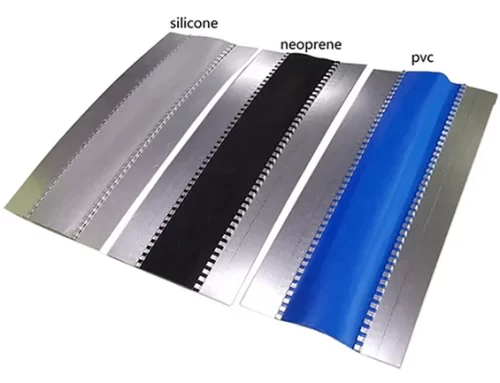
| Selection factor | Silicone-coated fiberglass | Neoprene-coated fiberglass | PVC-coated textile |
|---|---|---|---|
| General positioning | Higher-temperature flexible applications | Moderate-temperature industrial applications | Lower-temperature flexible applications |
| Typical substrate | Fiberglass | Fiberglass | Polyester, nylon, or other textile |
| Main evaluation points | Heat aging, flexibility, adhesion, sealing | Heat aging, flexibility, weathering, abrasion | Softening, dimensional stability, flexibility |
| Typical applications | Hot-air ducting, flexible connectors, insulation-related products | Ducting, connectors, equipment covers | Ventilation products, covers, flexible components |
| Important factors to verify | Actual temperature, exposure duration, pressure, movement | Actual compound and operating temperature | Actual temperature and mechanical load |
| Testing approach | Heat aging plus mechanical, adhesion, and application-specific testing | Heat aging plus relevant environmental and mechanical testing | Thermal, dimensional, flexibility, and load evaluation |
This table provides general selection guidance only. It does not establish universal temperature limits for any material.
Silicone-Coated Fiberglass
Silicone-coated fiberglass can be considered when the application requires a combination of:
- Elevated-temperature capability
- Flexible construction
- Fiberglass reinforcement
- Weather resistance
- Industrial durability
The actual suitability should still be evaluated according to temperature, duration, pressure, movement, and contact medium.
Neoprene-Coated Fiberglass
Neoprene-coated fiberglass can be considered for applications requiring moderate temperature resistance together with properties such as:
- Flexibility
- Weather resistance
- Abrasion resistance
- Industrial durability
The actual compound and application conditions should be checked before determining suitability.
PVC-Coated Fabric
PVC-coated fabric can be suitable for applications where priorities include:
- Flexibility
- Fabrication convenience
- Water resistance
- Cleanability
- Cost control
When the application involves elevated temperatures, the actual material construction and mechanical loading conditions should be evaluated.
Pre-Purchase Temperature-Resistance Checklist
Before approving a coated fabric, procurement managers and engineers can ask:
- Is the stated temperature continuous or short-term?
- How long was the specimen exposed?
- Which test method was used?
- Which standard edition was used?
- Which coating and substrate were tested?
- Does the tested thickness match the ordered material?
- Does the tested construction match the supplied product?
- Were relevant mechanical properties measured after exposure?
- Was coating adhesion evaluated?
- Was flexibility evaluated?
- Was dimensional change evaluated?
- Were pressure or leakage requirements considered?
- Were chemicals or moisture present?
- Was the specimen mechanically loaded?
- Were heating and cooling cycles relevant?
- Was the finished assembly tested where necessary?
- Does the report identify the sample or production batch?
- Are the acceptance criteria relevant to the actual application?
- Is third-party testing required?
If several of these questions cannot be answered, additional technical information or testing may be needed before bulk procurement.
Conclusion
Temperature resistance in rubber-coated fabrics cannot be accurately represented by one maximum-temperature number.
A meaningful evaluation should define:
temperature + exposure time + environment + mechanical conditions + measured property changes + acceptance criteria.
For rubber- or plastics-coated fabrics, accelerated-aging methods such as ISO 1419 can provide a useful way to evaluate deterioration under controlled conditions. Other standards, such as ISO 1421 for tensile properties and ISO 2411 for coating adhesion, can be used to evaluate specific properties before and after exposure.
For rubber compounds themselves, standards such as ISO 188 and ASTM D573 can provide useful heat-aging information, but their results should not automatically be treated as qualification of the complete coated-fabric construction. ASTM specifically notes that accelerated rubber-aging results may not correlate exactly with actual service performance.
For flexible ducts, connectors, expansion joints, insulation covers, and other finished products, the complete assembly may need additional evaluation because seams, cuffs, clamps, reinforcement, pressure, movement, and other components can affect actual performance.
The most reliable approach is therefore to match the test method to the real application rather than selecting a material from a temperature number alone.
Call to Action
I am Tina Tian from YEEDAH, a China-based B2B manufacturer specializing in coated fabrics and flexible industrial products.
We manufacture customizable silicone-coated fiberglass fabric, neoprene-coated fiberglass fabric, PVC-coated fabric, high-temperature flexible ducting, and fabric duct connectors for industrial applications.
If you are evaluating a coated fabric for a temperature-sensitive application, please send me the normal operating temperature, maximum temperature and exposure duration, heated medium, pressure or vacuum, movement conditions, required dimensions, and applicable test requirements at sales@yeedah.com.
Our technical team can then review the application and discuss a suitable material construction and sample evaluation plan.