Table of Contents
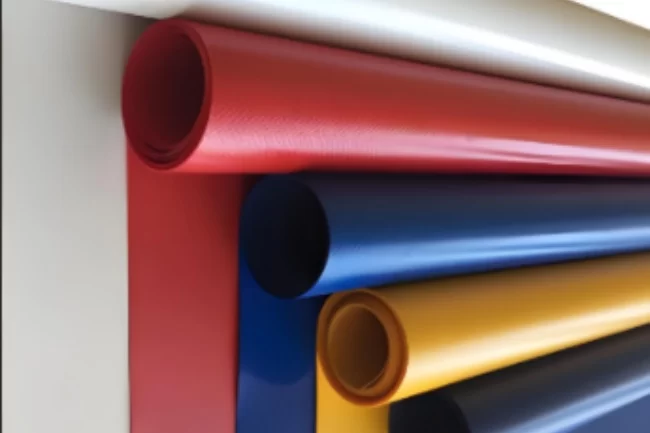
PVC coated fabric is used in many industrial products because it combines a flexible polymer surface with the mechanical reinforcement of a woven textile. Depending on its base fabric, PVC formulation, thickness, mechanical properties and test results, it may be fabricated into machinery covers, tarpaulins, flexible duct connectors, industrial curtains and certain specialized hoses.
However, “PVC coated fabric” describes a broad category rather than one standardized material. Two fabrics that look similar may perform very differently because of differences in their:
- Base-fabric material
- Yarn and weave construction
- Coating formulation
- Coating weight
- Finished thickness
- Tensile and tear strength
- Coating adhesion
- Temperature resistance
- UV and weathering performance
- Flame-retardant properties
- Fabrication characteristics
One PVC coated fabric grade should not automatically be assumed suitable for every application described in this article.
At YEEDAH, I regularly communicate with procurement managers, engineers, industrial distributors and product manufacturers who need to determine whether PVC coated fabric is appropriate for a particular project. In this article, I will explain the common industrial applications of PVC coated fabric, its important limitations and the specifications buyers should confirm before placing an order.
What Is PVC Coated Fabric?
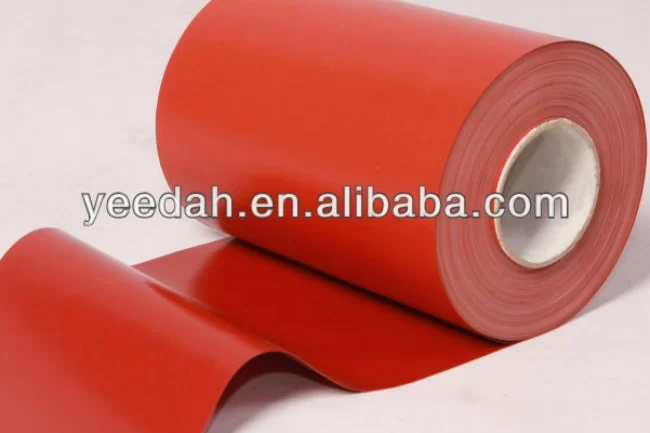
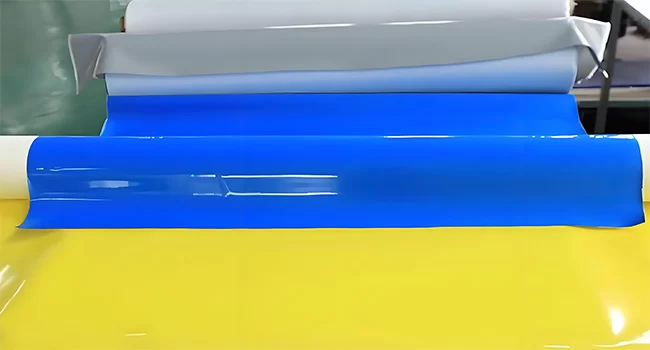
PVC coated fabric is generally made by applying polyvinyl chloride, or PVC, to a woven textile substrate. Polyester and nylon are two commonly used base-fabric materials.
Each part of the construction performs a different function:
- The base fabric provides much of the tensile strength, tear resistance, flexibility and dimensional stability.
- The PVC coating can provide water resistance, surface protection and a surface that is relatively easy to clean.
- Additives in the PVC formulation may modify properties such as flexibility, color, flame performance, UV stability and low-temperature performance.
- An additional surface finish may be applied to improve cleanability, appearance, printability or weathering performance.
The coating may be applied to one or both sides of the fabric. A single-sided coating may be sufficient when only one surface requires protection. A double-sided coating may be selected when both surfaces will be exposed or when the finished product requires improved sealing and cleanability.
PVC coated fabric can be manufactured with different:
- Base-fabric structures
- Coating weights
- Finished thicknesses
- Roll widths
- Colors
- Surface textures
- Gloss levels
- Flame-retardant formulations
- UV-stabilized formulations
- Welding and fabrication characteristics
Finished thickness alone does not determine the quality or suitability of PVC coated fabric. A thicker product with a weak substrate may perform worse than a thinner material made with a stronger and more appropriate base fabric.
Why Manufacturers Choose PVC Coated Fabric
Suitable grades of PVC coated fabric can provide a practical balance of flexibility, fabrication efficiency, water resistance and cost.
Its exact performance depends on the complete material construction and should be confirmed using the technical data and test results for the specific product.
Water and moisture resistance
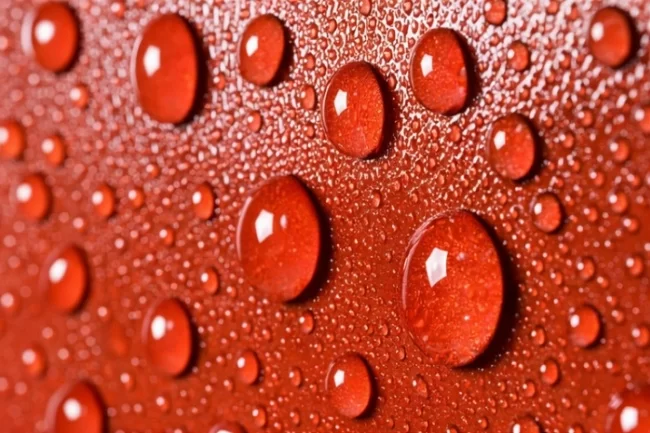
A continuous and undamaged PVC coating can provide a high level of water resistance. This makes suitable materials useful for covers, curtains, tarpaulins and barriers.
The finished product must still be evaluated separately. Water may enter through:
- Sewn seams
- Eyelets
- Fastener holes
- Closures
- Open edges
- Damaged coating
- Poorly welded joints
A water-resistant roll material does not automatically produce a completely waterproof finished product.
Mechanical durability
The woven substrate provides the main reinforcement, while the PVC coating protects the textile surface.
Actual tensile strength, tear strength, puncture resistance and abrasion performance vary according to:
- Yarn material and size
- Fabric density
- Weave construction
- Coating adhesion
- Coating thickness
- Total material construction
Reinforcement may be required around corners, fasteners, eyelets and areas exposed to repeated rubbing. Buyers should compare results obtained using the same test method rather than relying only on thickness or weight.
Cleanable surface
PVC coated surfaces are generally easier to wipe or wash than uncoated textiles. This can be useful in factories, warehouses, transport environments and other areas where the fabric may be exposed to dust, mud or water spray.
However, resistance to oils, disinfectants, cleaning agents and process chemicals depends on the PVC formulation and actual exposure conditions. A cleaning method should be tested before it is applied to the complete product.
Flexible fabrication
Depending on the formulation and construction, PVC coated fabric may be:
- Sewn
- Hot-air welded
- High-frequency welded
- Adhesively bonded
- Mechanically fastened
- Cut into customized shapes
- Reinforced with webbing, eyelets or metal strips
Welding can provide a more sealed joint than ordinary sewing in suitable applications. However, welding performance depends on the PVC formulation, coating thickness, base-fabric construction and equipment settings.
A trial seam should be produced and tested before bulk fabrication.
Customization possibilities
Industrial buyers may require customized:
- Colors
- Thicknesses
- Coating weights
- Roll widths
- Surface finishes
- Base-fabric constructions
- Finished dimensions
- Metal-strip widths
- Fabric widths
Customized specifications may involve minimum order quantities, sample costs and longer production lead times.
Flexible Connectors for HVAC and Ventilation Systems
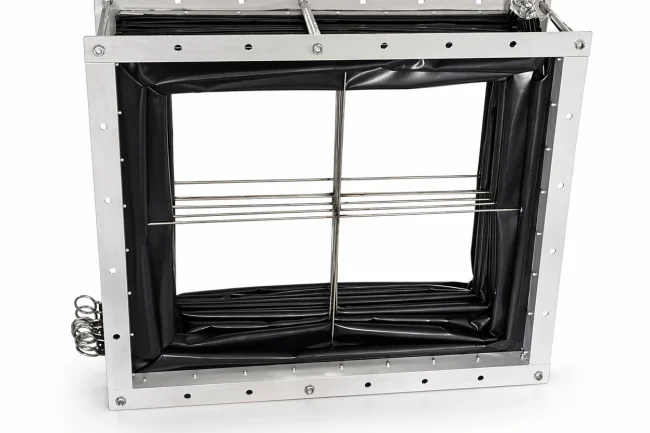
Rectangular flexible connector constructed with black PVC coated fabric, metal frames and internal support rods. The flexible fabric section helps isolate vibration and accommodate limited movement between ventilation equipment and rigid ductwork.
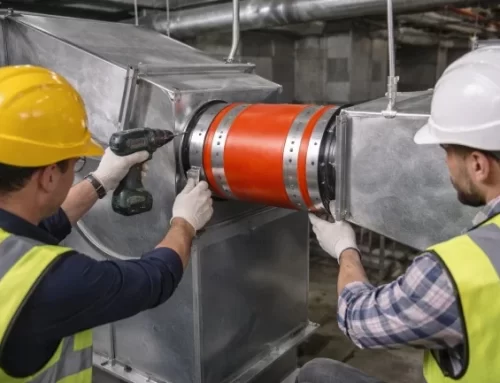
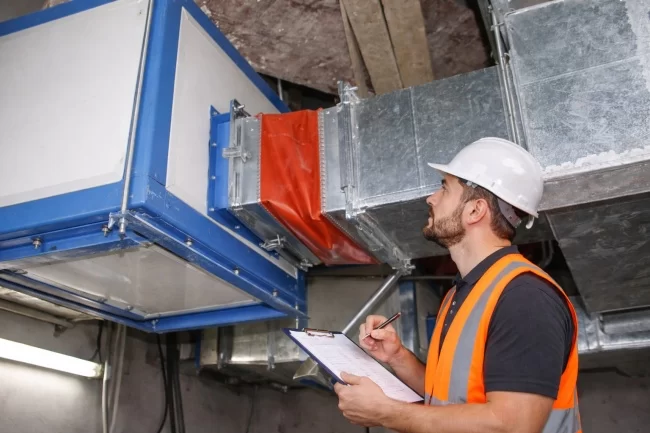
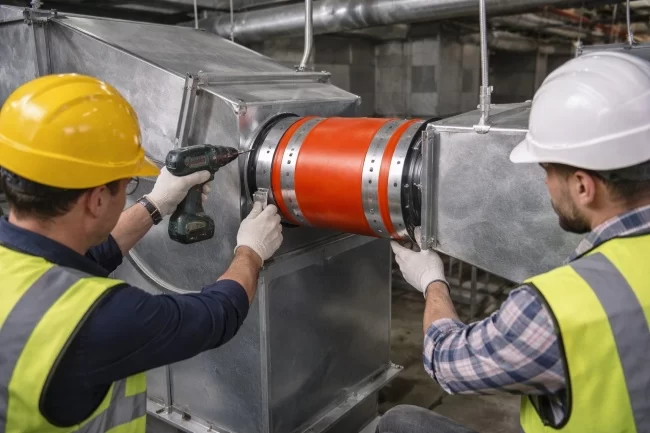
One of the most relevant industrial applications of PVC coated fabric for YEEDAH is the production of flexible duct connectors.
A flexible duct connector is installed between rigid ductwork and equipment such as:
- Fans
- Blowers
- Air-handling units
- Ventilation units
- Air-conditioning equipment
- Low-temperature processing equipment
The flexible fabric section helps reduce the direct transmission of equipment vibration into the surrounding metal ductwork. It may also accommodate minor installation misalignment and limited movement.
Construction of a PVC flexible duct connector
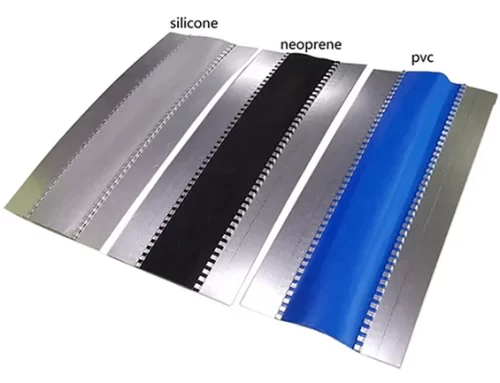
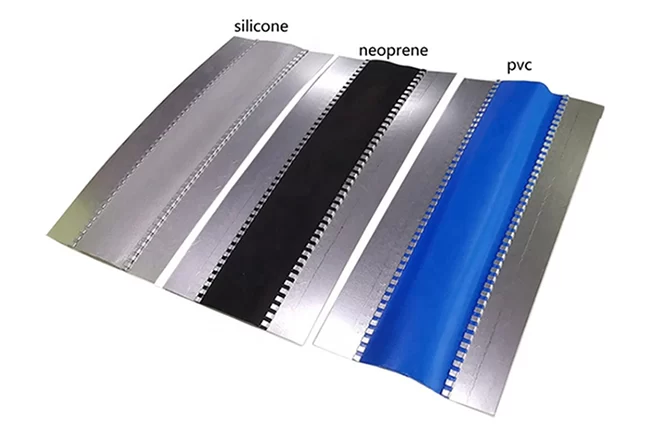
In the PVC flexible duct connectors supplied by YEEDAH, a strip of PVC coated fabric is mechanically joined to galvanized steel strips on both sides.
During duct fabrication, the galvanized strips are formed together with the metal ductwork, leaving the flexible PVC fabric section between the two rigid metal sections.
The finished product therefore consists of:
- A central PVC coated fabric strip
- A galvanized steel strip on one side
- A galvanized steel strip on the other side
- Continuous mechanical joints between the fabric and metal strips
This structure allows duct manufacturers to cut the connector roll to the required length and form it into rectangular or round duct connections.
When PVC is suitable
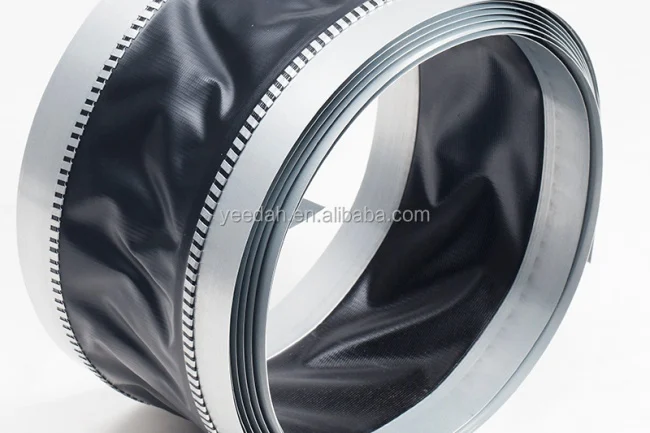
A round flexible duct connector consisting of black PVC coated fabric mechanically joined to galvanized steel strips on both sides. The flexible fabric section helps reduce vibration transmission between ventilation equipment and rigid metal ductwork.
A PVC flexible duct connector may be suitable when:
- The air temperature remains within the specified material range.
- The system is not exposed to continuous high-temperature airflow.
- The fabric is compatible with the transported air and surrounding environment.
- The pressure and vibration remain within the connector design limits.
- The application does not require a specialized high-temperature material.
- The complete connector meets the applicable fire and installation requirements.
The connector should not be treated as a pressure hose or as a component designed to absorb large axial, lateral or angular movements unless the complete assembly has been specifically engineered and tested for those conditions.
When to consider neoprene or silicone
PVC is not suitable for every ventilation system.
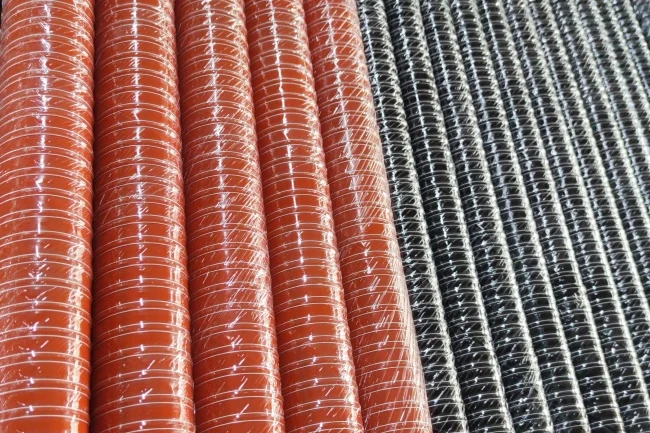
For higher operating temperatures, silicone coated fiberglass fabric may be more appropriate. Neoprene coated fiberglass fabric may be considered for certain intermediate-temperature or industrial environments.
Selection should be based on:
- Continuous temperature
- Short-term peak temperature
- Airflow conditions
- Pressure or suction
- Vibration
- Chemical exposure
- Flame-performance requirements
- Required service life
- Available test data
A material should not be selected solely because it is called PVC, neoprene or silicone.
Industrial Curtains, Partitions and Equipment Enclosures
Purpose-designed PVC coated fabrics are commonly used for industrial curtains and partitions.
Possible applications include:
- Warehouse partitions
- Production-area curtains
- Machine surrounds
- Dust-control barriers
- Washdown screens
- Maintenance enclosures
- Temporary work zones
- Storage-area dividers
The coated surface can help protect surrounding areas from dust, dirt and water spray. Different colors may also be used to identify work zones or separate production processes.
When specifying an industrial curtain, buyers should consider the complete assembly, including:
- Reinforced hems
- Eyelets
- Suspension rollers
- Hooks
- Weighted bottom edges
- Overlapping panels
- Access openings
- Replaceable sections
A standard PVC coated fabric should not automatically be described as flame-retardant. If fire performance is required, the buyer should specify the applicable test method and classification.
Terms such as “fireproof” should be avoided unless the finished product has been specifically tested and approved for the stated application.
Protective Covers for Machinery and Equipment
Suitable PVC coated fabrics may be fabricated into protective covers for:
- Industrial machinery
- Pumps
- Generators
- Compressors
- Control equipment
- Construction machinery
- Workshop tools
- Stored components
- Equipment transported between facilities
A properly designed cover may help protect equipment from rain, dust, dirt and general surface contamination.
Indoor and outdoor covers do not necessarily require the same material. Outdoor covers may need verified resistance to:
- Sunlight and UV exposure
- Rain and humidity
- Temperature changes
- Wind-induced movement
- Repeated folding
- Abrasion
- Coating aging
The attachment system is also important. Corners, straps, buckles and eyelets can create concentrated loads that cause the fabric to tear.
Ventilation should be considered carefully. A tightly closed water-resistant cover may trap moisture or condensation around the equipment. Depending on the application, the finished cover may require ventilation openings, drainage points, breathable sections or an air gap.
Truck Covers, Tarpaulins and Cargo Protection
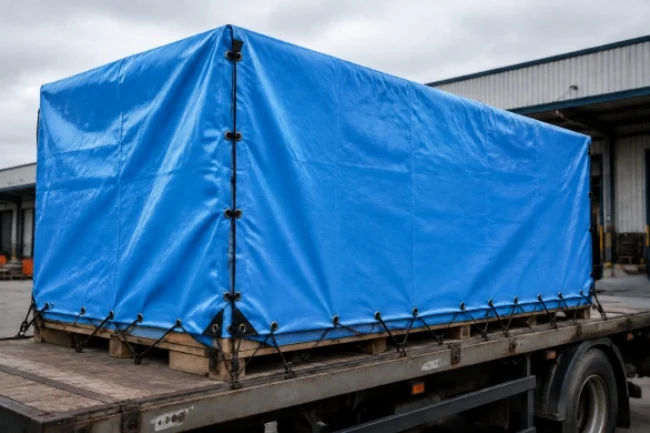
Blue PVC coated fabric used as a secured cargo cover on a flatbed truck. Transport covers require suitable tensile strength, tear resistance, weathering performance and reinforced fastening points.
Heavy-duty PVC coated polyester fabrics are widely used for truck covers, side curtains and cargo tarpaulins.
These products may be exposed to:
- Rain
- Sunlight
- Wind loading
- Road dirt
- Repeated folding
- Mechanical tension
- Abrasion
- Low-temperature handling
- Loads around ropes, straps and eyelets
They therefore require a material specifically developed and tested for transport and outdoor exposure.
Important properties may include:
- Tensile strength
- Tear strength
- Coating adhesion
- Abrasion resistance
- Low-temperature flexibility
- UV and weathering resistance
- Dimensional stability
- Resistance around attachment points
A lighter PVC fabric intended for flexible duct connectors, indoor curtains or equipment covers should not automatically be used for truck tarpaulins.
The complete cover design must also include properly reinforced corners, eyelets, hems and fastening points.
Temporary Shelters, Tents and Industrial Canopies
Purpose-designed PVC coated architectural or tarpaulin fabrics may be used as the outer membrane of certain:
- Temporary warehouses
- Maintenance shelters
- Construction tents
- Industrial canopies
- Outdoor work enclosures
- Storage extensions
These applications require more than basic water resistance. The material may need verified performance for:
- Structural tension
- Wind-induced movement
- UV exposure
- Outdoor weathering
- Low-temperature flexibility
- Seam strength
- Attachment strength
- Flame performance
- Expected service life
The coated fabric forms the protective skin, while the frame provides structural support. The fabric should not be treated as the load-bearing structure unless the complete system has been engineered for that purpose.
PVC fabrics used for flexible duct connectors should not be presented as architectural membrane or shelter materials unless their mechanical, weathering and fire performance has been separately verified.
Local building, fire and safety requirements should be confirmed before the installation of any temporary or semi-permanent structure.
Containment Liners and Protective Barriers
Certain purpose-designed PVC coated fabrics may be fabricated into temporary:
- Equipment drip trays
- Washdown barriers
- Protective liners
- Secondary containment products
- Flexible collection products for compatible media
Suitability cannot be determined from the term “PVC coated fabric” alone.
The buyer should identify:
- The liquid or chemical
- Chemical concentration
- Exposure temperature
- Contact duration
- Cleaning process
- Required containment standard
- Seam construction
- Expected mechanical stress
Standard PVC fabric should not automatically be specified for fuels, solvents, concentrated acids, concentrated alkalis or hazardous chemicals.
Where leakage could create a safety or environmental risk, the complete containment product should be engineered and tested by a qualified manufacturer. Testing should include both the roll material and the fabricated seams.
Puncture resistance is also important. A chemically compatible liner may still fail if it is installed over sharp debris or an uneven surface. Surface preparation or a protective underlayer may therefore be required.
Agricultural, Construction and Outdoor Protection
Suitable PVC coated fabrics may be used for products such as:
- Construction-material covers
- Weather screens
- Temporary ground covers
- Agricultural equipment covers
- Storage curtains
- Temporary roof covers
- Outdoor stockpile protection
These products may be exposed to mud, rain, sunlight, wind and repeated handling.
The required construction depends on whether the product will be used for several days, one season or several years.
For outdoor applications, buyers should consider:
- UV and weathering resistance
- Coating adhesion after environmental exposure
- Low-temperature flexibility
- Tear strength
- Abrasion resistance
- Plasticizer migration where relevant
- Reinforced attachment points
- Expected service life
Wind can generate substantial loads on a large sheet. The material, supporting structure, fastening method and spacing of attachment points must be evaluated as part of the complete design.
Outdoor suitability should be supported by relevant technical data rather than assumed from the appearance of the fabric.
Inflatable and Welded PVC Products
Some PVC coated fabrics are specifically developed for welded inflatable products, air-supported structures or flexible containers for compatible media.
These are specialized constructions and should not be confused with general-purpose PVC coated fabric.
Such applications may require verified:
- Coating uniformity
- Weldability
- Seam strength
- Air or liquid retention
- Pressure resistance
- Flex-fatigue performance
- Leakage performance
- Repeated-folding resistance
- Chemical compatibility
A PVC fabric used for flexible duct connectors should not be promoted for inflatable structures or flexible tanks unless the material and finished seams have been tested for that particular application.
A prototype should be produced before mass manufacturing. Testing should reflect the intended pressure, cyclic loading, folding frequency, temperature, leakage requirements and environmental exposure.
Specialized Hose and Suction Applications
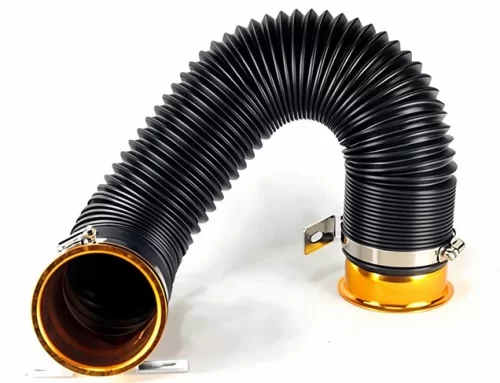
PVC coated textile can be used as part of the wall construction in certain flexible hoses. A spiral wire or other reinforcement may be incorporated to reduce collapse during bending or suction.
Depending on the construction, these hoses may be used for:
- Low-pressure air handling
- Ventilation
- Light suction
- Equipment connections
- Dental suction systems
A hose designed for general ventilation does not automatically meet the requirements for dental equipment or another specialized application.
Important specifications include:
- Internal diameter
- Wall construction
- Reinforcement type
- Bend radius
- Inner-surface characteristics
- Suction resistance
- Pressure capability
- Flexibility
- Temperature range
- Chemical compatibility
- Cleaning method
- Applicable hygiene requirements
For PVC dental suction hoses, buyers should also confirm odor requirements, cleaning procedures, surface characteristics and any regulations applicable in the destination market.
PVC Coated Fabric Compared with Other Coated Industrial Fabrics
PVC, neoprene and silicone coated fabrics serve different operating conditions. One material is not universally better than the others.
| Material | Typical characteristics | Important limitations | Common application direction |
|---|---|---|---|
| PVC coated polyester or nylon | Flexible, water-resistant, cleanable and suitable for certain welding processes | Temperature, UV, chemical and flame performance vary by formulation | General covers, curtains, low-temperature flexible connectors and selected fabricated products |
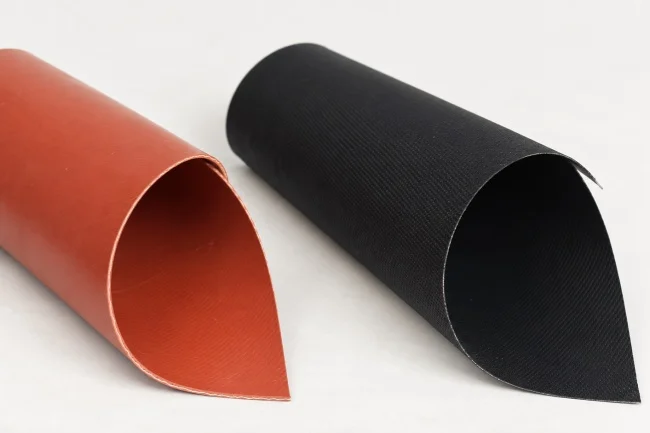
| Neoprene coated fiberglass | Fiberglass reinforcement provides dimensional stability; suitable grades tolerate higher temperatures than general-purpose PVC fabric | Fabrication methods differ from PVC; performance must be confirmed using product-specific data | Industrial flexible connectors, ducting and protective components |
| Silicone coated fiberglass | Suitable grades provide high-temperature capability, flexibility and dimensional stability | Higher cost; not automatically suitable for every chemical, abrasion or pressure condition | Hot-air ducting, thermal protection and high-temperature flexible connectors |
| Uncoated textile | Lightweight, flexible and breathable | Limited sealing, water resistance and contamination protection | Applications in which breathability is more important than water or air retention |
Material selection should follow the actual operating environment rather than the lowest initial price or a general material name.
Key Specifications Buyers Should Confirm
A clear specification helps the manufacturer recommend an appropriate material and prepare a reliable quotation.
Base fabric and coating construction
Buyers should confirm:
- Base-fabric material
- Yarn and weave construction
- Fabric density
- Single-sided or double-sided coating
- Finished thickness
- Weight per square metre
- Coating weight where relevant
- Roll width
- Color
- Surface finish
The base fabric carries much of the mechanical load. Its material, yarn size and weave structure can have a major effect on tensile strength, tear resistance and dimensional stability.
Mechanical performance
Depending on the application, buyers may need data for:
- Tensile strength
- Tear strength
- Abrasion resistance
- Puncture resistance
- Coating adhesion
- Flex-fatigue resistance
- Dimensional stability
The applicable test method and measurement direction should be stated. Woven fabrics can have different properties in the warp and weft directions.
Values obtained using different test methods should not be compared directly.
Environmental and chemical performance
The specification should identify all expected exposure conditions, including:
- Continuous operating temperature
- Short-term peak temperature
- Outdoor exposure
- UV radiation
- Rain and humidity
- Low-temperature folding
- Oils and greases
- Cleaning agents
- Process chemicals
A maximum temperature should be connected to a material grade, test condition and exposure duration. Continuous operating temperature and short-term peak temperature are not interchangeable.
Chemical resistance also varies according to the substance, concentration, temperature and contact duration. Compatibility testing may be necessary for critical applications.
Safety and compliance requirements
Required documentation may include:
- Flame-performance test reports
- REACH documentation
- RoHS documentation
- Restricted-substance declarations
- Market-specific safety documents
- Application-specific certificates
A supplier declaration is not the same as an independent laboratory report.
The availability of a declaration does not necessarily mean that every production batch or every listed substance has been independently tested. Buyers should distinguish among:
- Supplier declarations
- Raw-material information
- Internal test data
- Independent laboratory reports
- Product certifications
If flame performance is required, the buyer should provide the exact test method and required classification.
Fabrication and installation requirements
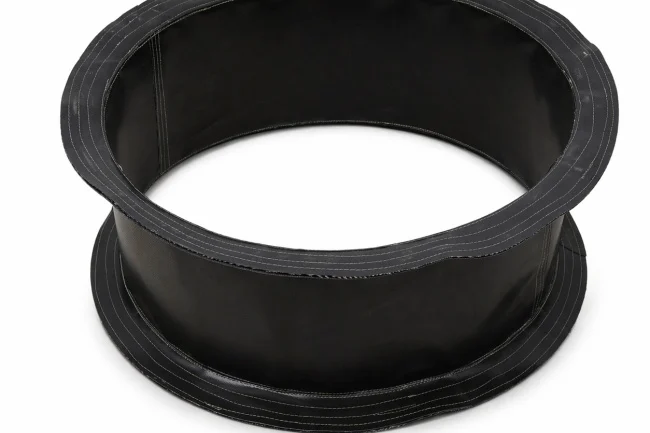
Round flexible duct connector made with black PVC coated fabric and reinforced stitched flanges. It is designed to provide a flexible connection between compatible ventilation equipment and ductwork under suitable temperature and operating conditions.
A technically suitable roll material may still fail if the finished component is poorly designed or fabricated.
Buyers should provide information about:
- Welding, sewing or bonding method
- Required seam strength
- Airtightness or water-resistance requirements
- Reinforced edges
- Eyelets and fasteners
- Metal strips or flanges
- Finished dimensions
- Dimensional tolerances
- Installation method
- Vibration and movement
- Pressure or suction
Drawings and representative samples are especially useful for customized connectors, covers and hoses.
Common Mistakes When Selecting PVC Coated Fabric
Selecting material by thickness alone
Thickness does not describe the base-fabric strength, tear resistance, coating adhesion or overall durability.
The entire construction should be evaluated.
Ignoring the base fabric
The textile substrate carries much of the mechanical load. Its yarn material, density and weave can be as important as the PVC coating.
Assuming every PVC coating performs the same way
PVC formulations vary. A material developed for welding may not provide the same outdoor durability as a material specifically formulated for tarpaulins or architectural use.
Using PVC too close to a high-temperature source
PVC coated fabric should not be substituted for a high-temperature material without technical verification.
Hot-air ducts, ovens, exhaust systems and heated machinery may require silicone coated fiberglass or another purpose-designed construction.
Overlooking stress concentration
Eyelets, corners, straps, holes and rigid fasteners concentrate loads in small areas. These locations may require reinforcement or a redesigned attachment method.
Confusing water resistance with airtightness
A coated surface may resist water, but sewn seams and attachment points may still allow air or water to pass.
Airtight or waterproof finished products require suitable seams, closures and inspection procedures.
Requesting flame-retardant material without defining the standard
Different industries and markets use different fire tests. The buyer should specify the required test method, classification, material thickness and intended application.
Assuming chemical resistance
A PVC coating is not universally resistant to oils, solvents, acids, alkalis or cleaning chemicals. Compatibility must be evaluated under the actual exposure conditions.
Skipping finished-product testing
Testing the roll material does not verify welded seams, eyelets, valves, metal joints, flanges or assembled components.
A pre-production sample can identify problems before bulk manufacturing.
How to Select the Right PVC Coated Fabric for an Industrial Project
1. Define the function
Clarify whether the material will be used to:
- Cover
- Connect
- Contain
- Shield
- Separate
- Carry air
- Carry liquid
Each function creates different performance requirements.
2. Record the operating temperature
Provide the normal continuous temperature and any short-term peak temperature.
Also explain whether the heat comes from:
- Airflow
- Radiant heat
- Direct contact
- Surrounding equipment
- Outdoor conditions
3. Identify the mechanical loads
Consider:
- Pressure
- Suction
- Vibration
- Repeated folding
- Abrasion
- Wind loading
- Movement
- Handling frequency
4. Identify environmental exposure
State whether the product will encounter:
- Sunlight
- Rain
- Humidity
- Cold weather
- Dust
- Oil
- Cleaning agents
- Process chemicals
5. Establish the required service life
A temporary cover and a reusable outdoor enclosure should not be specified in the same way.
Expected service life affects the appropriate construction and cost.
6. Confirm regulatory requirements
Identify required:
- Fire tests
- Restricted-substance documentation
- Industry standards
- Destination-market requirements
- Application-specific certificates
These requirements should be confirmed before production.
7. Select the fabrication method
Determine whether the finished product will be:
- Welded
- Sewn
- Bonded
- Clamped
- Mechanically fastened
- Joined to metal strips
The selected material must be compatible with the intended process.
8. Request technical data and samples
Before mass production, buyers should request available technical data, representative samples and relevant test reports.
The sample should be evaluated under conditions that resemble the actual application.
9. Test the finished prototype
For customized products, testing the finished component is often more useful than testing only the roll material.
A prototype may be used to verify:
- Dimensions
- Fit
- Seam strength
- Flexibility
- Installation
- Movement
- Leakage
- Vibration performance
Questions to Ask a PVC Coated Fabric Manufacturer
Procurement managers and engineers may ask:
- What is the base-fabric material and construction?
- Is the PVC coating applied to one side or both sides?
- What are the finished thickness and weight tolerances?
- Which tensile and tear test methods are used?
- Is the material suitable for the intended welding process?
- What is the recommended continuous operating-temperature range?
- Has the material been tested for UV or outdoor exposure?
- Which flame-performance classifications are available?
- Which REACH, RoHS or restricted-substance documents are available?
- Are customized colors, widths or coating weights available?
- What is the minimum order quantity for a customized specification?
- Can a representative or pre-production sample be supplied?
- How is coating consistency controlled between production batches?
- How should the material be cleaned and stored?
- Which application information is required for an accurate quotation?
For customized components, I recommend providing drawings, dimensions, application photographs, operating conditions and the estimated order quantity.
This information is more useful than providing only a product name.
Frequently Asked Questions About PVC Coated Fabric
Is PVC coated fabric completely waterproof?
A continuous PVC coating can provide a high level of water resistance. However, finished-product performance also depends on seams, eyelets, closures, openings, cut edges and fabrication quality.
Waterproof performance should therefore be evaluated at the finished-product level.
Can PVC coated fabric be used outdoors?
Some grades are designed for outdoor use, but outdoor suitability should not be assumed for every PVC coated fabric.
Buyers should confirm:
- UV stability
- Weathering resistance
- Low-temperature flexibility
- Coating adhesion
- Expected service life
A material intended for an indoor flexible duct connector may not be suitable for a long-term outdoor cover.
Can PVC coated fabric be used for high-temperature applications?
PVC coated fabric is generally intended for lower-temperature applications than silicone or neoprene coated fiberglass materials.
Its allowable temperature must be confirmed using the technical data for the specific grade.
For hot-air ducting, heated equipment or thermal protection, silicone coated fiberglass fabric may be more appropriate.
Can PVC coated fabric be welded?
Many PVC coated fabrics can be fabricated using hot-air welding or high-frequency welding.
Suitability depends on the PVC formulation, coating thickness, base-fabric structure and welding settings. A trial seam should be produced and tested before bulk fabrication.
How do I choose the correct thickness?
Thickness should be evaluated together with:
- Base-fabric strength
- Tear resistance
- Abrasion exposure
- Pressure or suction
- Handling frequency
- Attachment method
- Required flexibility
- Expected service life
A thicker material is not automatically stronger or more suitable.
Is PVC coated fabric resistant to chemicals?
Chemical resistance varies according to:
- Chemical type
- Concentration
- Temperature
- Contact duration
- PVC formulation
- Mechanical stress
For critical applications, buyers should provide complete chemical and operating information and conduct compatibility testing on a representative sample and finished seam.
Conclusion
PVC coated fabric is a versatile industrial material, but its suitability depends on the specific material construction and actual operating conditions.
Purpose-designed grades may be used for:
- Flexible duct connectors
- Industrial curtains
- Machinery covers
- Cargo tarpaulins
- Temporary shelters
- Protective barriers
- Selected welded products
- Specialized hoses
However, one PVC coated fabric grade should not be assumed suitable for all of these applications.
Procurement managers and engineers should evaluate the base fabric, coating construction, mechanical properties, operating temperature, environmental exposure, fabrication method, compliance requirements and finished-product design.
Where higher temperatures are involved, PVC should also be compared with neoprene coated fiberglass and silicone coated fiberglass materials.
The most reliable selection process is to review technical data, test representative samples and evaluate the finished product under realistic operating conditions.
Call to Action
At YEEDAH, we manufacture PVC coated fabric for selected industrial applications and PVC flexible duct connectors consisting of a flexible PVC fabric section joined to galvanized steel strips on both sides.
We also manufacture PVC dental suction hoses, silicone coated fiberglass fabric and neoprene coated fiberglass fabric for applications requiring different temperature and construction characteristics.
The suitability of a material depends on the actual application and required standards. Before recommending a product, we normally review:
- Required dimensions
- Continuous and peak temperatures
- Pressure or suction conditions
- Vibration and movement
- Fabrication method
- Application environment
- Required standards
- Order quantity
For a wholesale or customized enquiry, please send your technical drawing, dimensions, application photographs, operating conditions and estimated quantity to sales@yeedah.com